
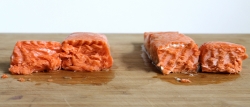
Fish has a reputation for being difficult to cook — when preparing it in a traditional manner, tender fillets can go from perfectly cooked to dry and stringy in a matter of seconds. Precision cooking eliminates this problem. Take the two salmon filets pictured above. The salmon on the left has been cooked at 122 degrees in the Anova Precision Cooker for 40 minutes. It is perfectly cooked from edge to edge and end to end. This fillet has a tender, flaky texture, packed with moisture. A small amount of white albumin was pushed out of the fish, but it collected in the sous vide bag. The salmon on the right was baked in a 350 degree oven until its thickest part registered 125 degrees. Even in the center, its flesh is far more dry and compact than the sous vide fillet, and the white albumin is visibly apparent. Worse, the thinner tail end of the fillet is close to inedibly dry, an expensive problem when cooking with salmon. Which would you rather eat?
Kate Williams
Kate is a freelance food writer and editor living in Berkeley, CA. Before moving to the Bay Area, Kate spent two years working as a test cook at America’s Test Kitchen, and has contributed to Serious Eats, The Oxford American, KQED and The Hypocrite Reader, among others. She's currently the editor of Berkeleyside NOSH.